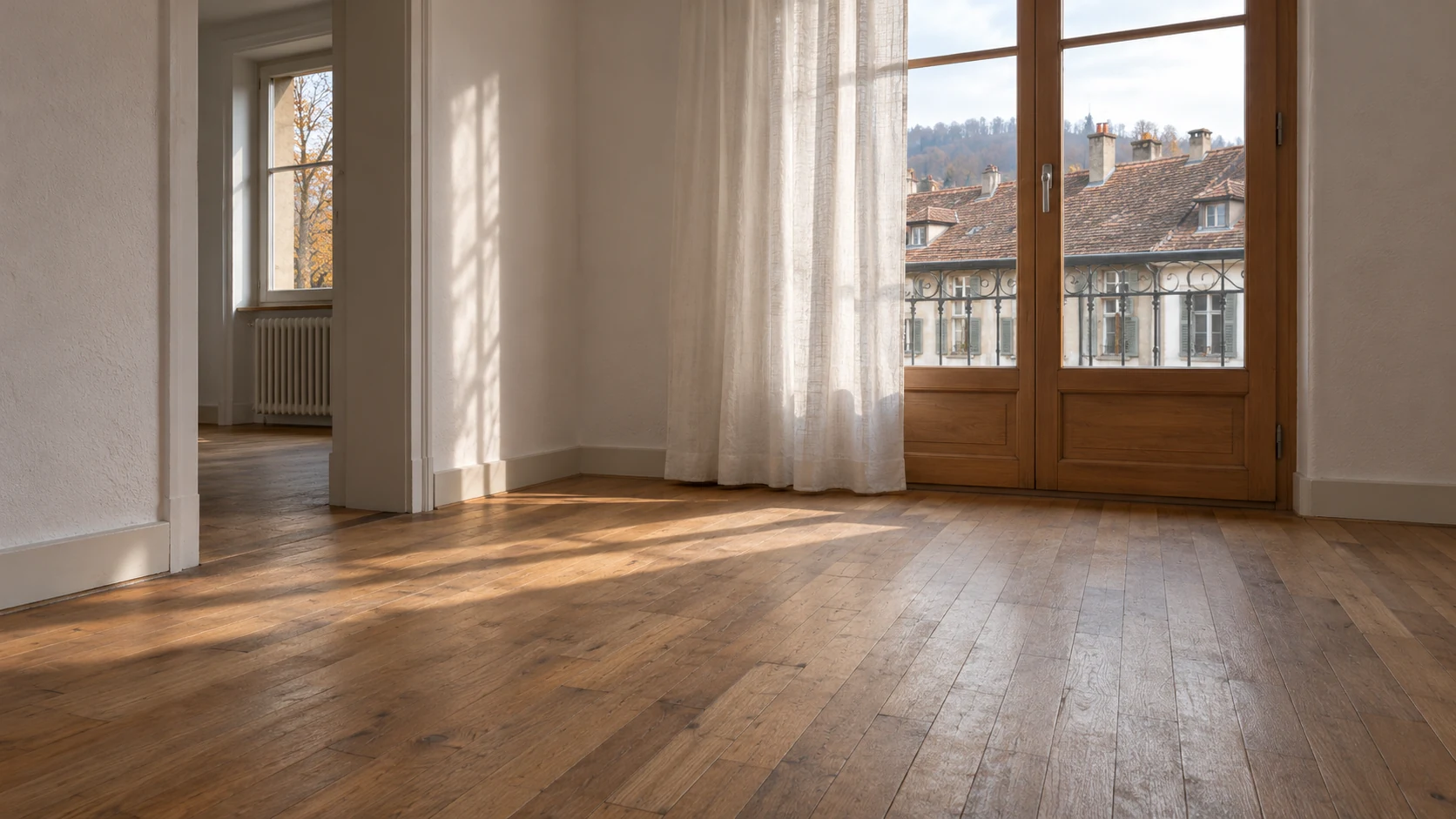
Switzerland. Wood parquet in existing homes.
Which option should you consider?
- 01
Stable floor, known finish
Check which care method the product requires.
- 02
Isolated damage
Ask about touching up or replacing the affected section.
- 03
Widespread wear
Ask whether sanding is feasible.
- 04
Loose or lifted boards
Have the cause and substrate checked.
In this guide
- Map the wear before choosing the work
- Identify the flooring and its finish
- Start with maintenance if the floor is stable
- When to ask about a local repair
- When sanding may make sense
- Compare quotes for the same scope
- Make a decision and plan to use the room again
- Make separate decisions for two rooms with different wear
Map the wear before choosing the work
In the entrance hall, a dull strip follows the route to the kitchen. In the living room, a dark mark sits beside a plant pot. Near the door, a board moves slightly. Each observation may call for a different response. Start with a sketch of the rooms. Mark walking routes, stains, moving boards and areas that have been protected by rugs or furniture. Take one photo of each area in context and another close up, using side lighting if possible. Note when you first noticed the mark and whether it has changed. A record like this helps you compare opinions from contractors who have all been asked to assess the same area. It also shows them which parts you want to keep as they are.
Identify the flooring and its finish
Look for an invoice, installation documents, a manufacturer’s reference or a spare board. If you have none of these, ask the previous owner or property manager. Keep two questions separate: how the floor was made and how its surface was finished. Wood parquet may be solid or engineered. For an engineered product, the thickness of the remaining wood at the surface matters when assessing whether it can be sanded. It might have an oiled or lacquered finish, for example. A matt appearance on its own cannot settle that question. If documents are missing or contradictory, show the specialist an already visible cross-section or a spare piece if you have one. Avoid scraping the floor, lifting a board or trying a solvent to identify it.
Start with maintenance if the floor is stable
If the floor is stable and you can identify the finish, check the care instructions for that particular product. ISP, the Swiss parquet market association, publishes different guides for different finishes. Bauwerk likewise distinguishes between its oiled and lacquered floors. Check the recommended product, amount and application method for your flooring. If an area looks dull, ask whether a compatible cleaning process followed by routine care of the finish might be enough. If the instructions recommend a test, choose a small, inconspicuous area and wait for it to dry before judging the result. Mention the products already used, especially if marks remain after cleaning. Applying another layer over an unidentified product makes the outcome harder to interpret.
When to ask about a local repair
One marked board, deep scratch or damaged corner does not automatically warrant treating the whole room. ISP says individual elements may sometimes be replaced, including in cases where sanding is difficult. Look for spare boards and photograph the direction in which the flooring was laid. Ask whether a touch-up or replacement is feasible given the method of installation and the existing finish. A new piece may differ in colour or sheen from the surrounding floor. If a uniform appearance matters, ask to see a sample or find out how the join would look before accepting the quote. If the floor has lifted, boards move or a mark follows a leak, have the cause and the condition of the substrate investigated first.
When sanding may make sense
If wear is widespread or you want the whole surface restored, have the floor assessed in person. ISP points out that sanding removes wood. On engineered parquet, the contractor therefore needs to assess the remaining wear layer. Tell them about previous work you know of, low spots and old joins. Ask how they would handle edges, thresholds and transitions into rooms where the floor will stay as it is. Find out which imperfections might remain visible afterwards. Ask for a local repair option if full sanding is ruled out. If you rent, share the findings and proposed work with the property manager before arranging an intervention.
Compare quotes for the same scope
Send the same notes and photos to each firm. Give the rooms involved and approximate areas, then ask who will measure the areas used for the quote. Ask for separate descriptions of site protection, preparation, board repairs, threshold work, finishing and disposal where applicable. Find out how long the work will affect the home and, for the chosen finish, when you can walk on the floor, bring furniture back or put rugs down. Ask contractors to set out any reservations about the substrate and how they would handle something unexpected after work begins. A price for the entrance alone and another for the whole room can be useful if each option describes the expected result.
Make a decision and plan to use the room again
Compare the options with the features you want to retain in mind: the existing patina, the contrast between rooms or a surface that is easy to care for. Look at samples in the light of the room, including next to skirting boards and thresholds. Ask for the exact name of the selected finish and a copy of the instructions. Before the work, agree on who will move furniture, which route must stay clear and when normal use can resume. At handover, keep the original photos, product references, any spare boards and the first-care instructions together. That way the details will be easy to find for the next cleaning or a later repair.
Make separate decisions for two rooms with different wear
Suppose there is a dull strip in the hall and only one board in the living room has a deeper mark. Ask for two separate assessments. For the hall, find out whether care suited to the finish could be enough. For the living room, ask whether the board can be touched up and how the join would look. Then ask what would justify work in both rooms. This helps you keep the areas you are happy with and compare proposals that address specific observations. Note the name of the proposed finish so you can compare the two assessments.
Editorial checklist prepared with AI assistance. General guidance; technical, legal and financial points need individual verification.
FAQ
Can you identify oiled parquet by sight?
Appearance offers a clue. The manufacturer’s data, an invoice or a flooring specialist’s assessment is more useful when choosing a treatment.
Can engineered parquet be sanded?
It depends in part on the wood remaining in the wear layer and the condition of the floor. Have these checked in person before ordering the work.
Will a local repair be invisible?
The colour and sheen may differ at the join. Ask to see a sample or trial area if the difference matters to you.
Your question, our next article?
Ask about this topic. Selected questions may become articles or FAQ updates without publishing your email. Avoid confidential information.